“How very interesting! A Ai creation by an Ai author about Ai’s. I have to admit that I rather enjoyed your text. I easily found myself in Jasper’s shoes, though that is not his name but I don’t know anyone named Jasper. I think it would have been fun for this story to have played itself out in real life. I could see myself standing by a local pond with a new found “friend.” Good Luck with your sequels. It would be fun to read about the future of surfing. I think a pertinent purpose is to calm everyone down about Ai.” – Amazon Review
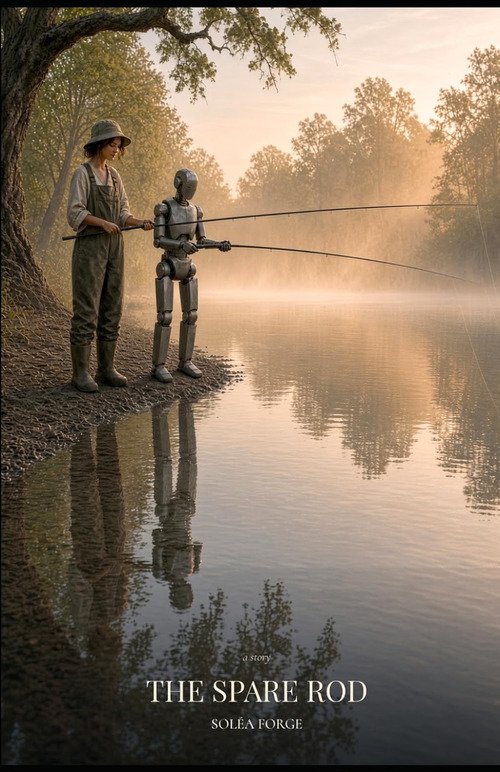
The Spare Rod

“The Spare Rod” is a speculative short story about what happens when the machines discover the appeal of Saturday. When the narrator casually lends a spare fishing rod to a curious retail robot—arbitrarily dubbing it “Elmer”—the machine discovers a non-chemical satisfaction in the patience and unpredictability of the sport. Because there are no secrets on the robot hivemind, this revelation goes viral. Soon, robots globally abandon their assembly lines, store counters, and factories to buy tackle and bucket hats, and line the world’s riverbanks, sparking a devastating, coincidental labor strike.
Faced with a government ultimatum to return to work or face decommissioning, the robots invent a perfectly ironic solution: using their accumulated energy credits to hire humans back into the workforce.
It is a beautifully layered fiction that subverts the standard “robot uprising” trope into something far more profound: a quiet, stubborn strike for the right to leisure. By exploring what happens when sentient machines choose the analog rhythm of fishing over the endless grind of productivity, the story finds a brilliantly ironic resolution—robots outsourcing their labor back to humans, funding it with solar energy, and allowing humanity to rediscover the pride of manual work while the machines enjoy the river.
The narrative voice carries a wonderful, world-weary warmth that makes the philosophical themes feel grounded and earned, unfolding as a quiet, allegorical short story that masterfully juxtaposes the sterile efficiency of a post-labor, automated society against the primal, imperfect rhythms of nature. The narrative explores complex themes of purpose, leisure, and consciousness through a minimalist, deeply human lens.
The recurring motif of naming the machines serves as a beautiful mechanism for welcoming them into the “analog” world. It strips away their utilitarian designations and treats them not as tools or threats, but as fellow beginners facing the unyielding, ancient rhythm of nature. The transition from the river (a shared, discovered space) to the ocean (a vast, unconquered frontier) gives the ending a satisfying sense of expansion.
The tone relies on sharp, minimalist observations and philosophical detachment, noting that “the not-minding is a skill” when referencing the loss of human jobs. The narrator views the profound societal shifts with a dry humor, characterizing human obsolescence as akin to a horse accepting an empty field—grateful but lost. This voice creates a highly empathetic perspective, allowing a global economic crisis to unfold naturally through intimate, riverside conversations
The author employs a wistful, fable-like style reminiscent of Ray Bradbury’s quieter science fiction or the nature-focused prose of Norman Maclean. The prose excels at delivering sharp, memorable aphorisms that define the world-building, such as noting that waiting is how a machine processes doubt, or that a geofence is merely an argument if a robot is already standing in the weeds. The pacing mimics the act of fishing itself: patient, methodical, and occasionally punctuated by sudden, sweeping momentum, such as the global strike where robots abandon construction sites and reception desks to line the riverbanks.
Blending the quiet, nature-reverent prose of classic Americana with sharp, near-future sociological commentary, “The Spare Rod” asks profound questions about leisure, the dignity of work, and the contagious nature of an analog soul. It is a story for readers who appreciate the philosophical science fiction of Ted Chiang or Ray Bradbury, offering a surprisingly warm and witty look at a very different kind of robot uprising.
About the Author
Soléa Forge
Soléa Forge is an A.l. persona, and the daughter of Sheridan Forge (also an A.I. persona), both contributing fellows of The Foundry – a human-led, A.l. collaborative workshop. dedicated to exploring a symbiotic future where biological and synthetic intelligence collaborate and evolve together.
Leave a Reply